Othello search engine and pruning ablation
An Othello engine in Java with four search shortcuts stacked together. It searches 15.5× fewer positions than plain alpha-beta search, yet loses to it in timed games; I measured why.
- Stack
- Java 8, Alpha-beta / PVS, Transposition table, Multi-ProbCut, Optuna
15.5×
fewer positions searched than plain alpha-beta
same depth, 24 midgame positions
4.45
moves considered per position, down from 11.8
median over 24 positions
42%
score against plain alpha-beta at equal time
60 games: 23 wins, 32 losses, 5 draws
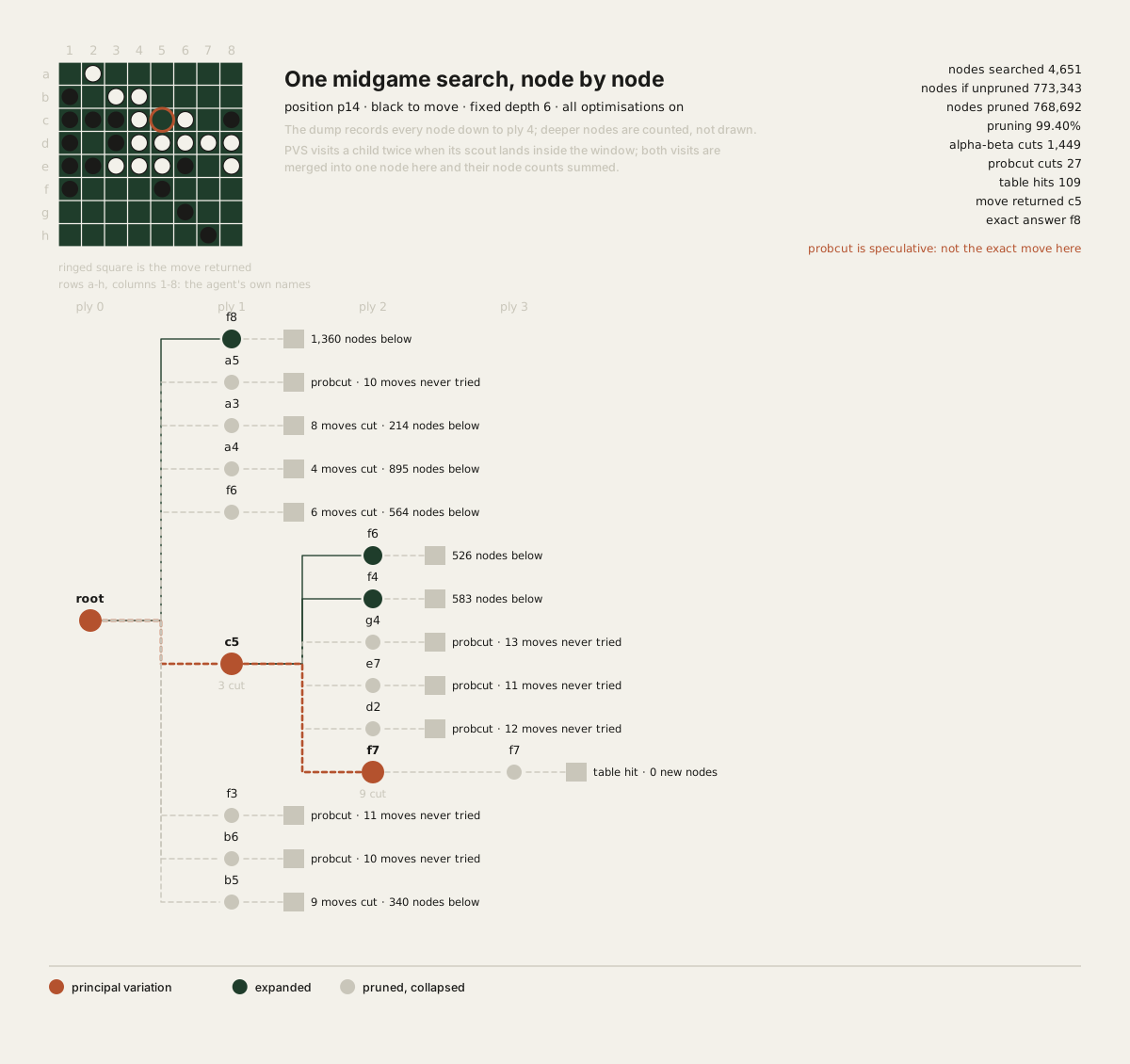
An excerpt from a recorded game. Each move shows the square the engine chose and how many positions it searched, compared with plain alpha-beta on the same position.
Overview
Problem
A game engine looks ahead through possible moves, and the positions multiply with every move. Engines use shortcuts to skip parts of that search. I wanted to measure what each shortcut actually saves in an Othello engine, and whether searching less turns into winning more.
Approach
- The Java engine starts from alpha-beta search, which skips moves that cannot change the result, and adds three more shortcuts: principal variation search, which checks the most promising move first; a transposition table, a memory of positions already evaluated; and multi-ProbCut, which predicts which lines are not worth searching.
- Positions are scored on 20 features, such as corner control, mobility and stable discs, with weights tuned automatically.
- Each version, adding one shortcut at a time, searched the same 24 midgame positions to a fixed depth; versions then played 60-game matches with equal time per move.
Results
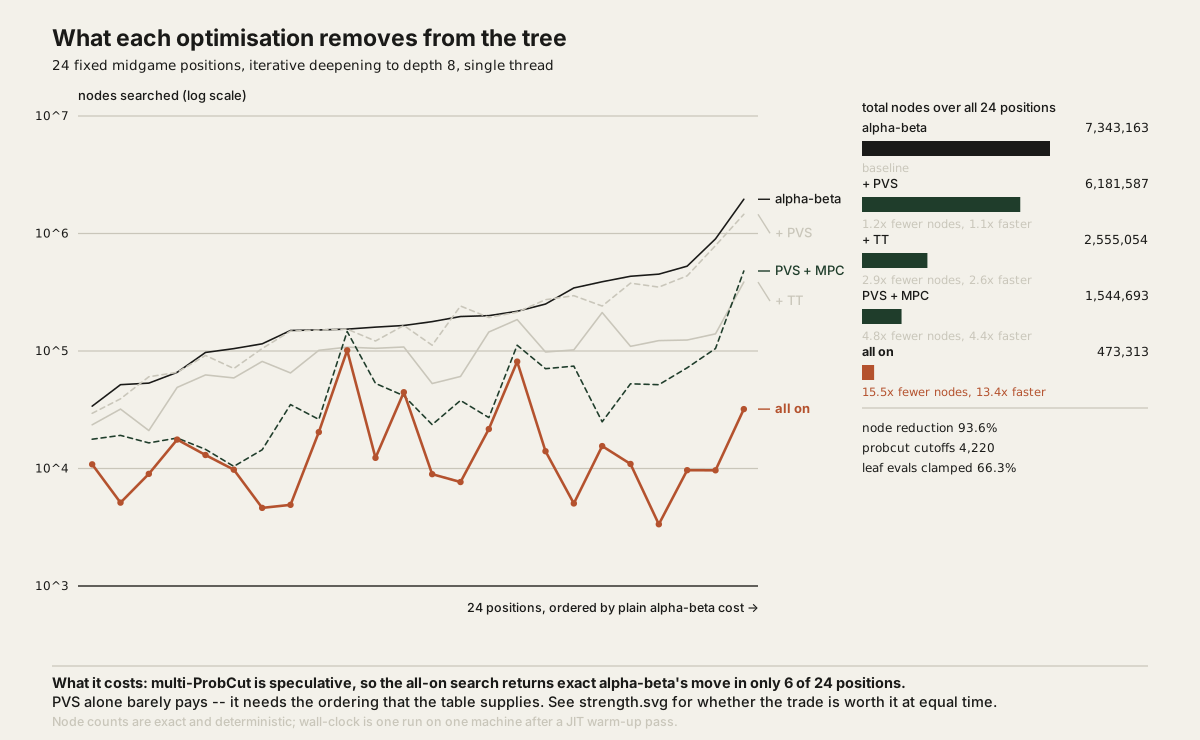
With every shortcut on, the engine searched 15.5× fewer positions than plain alpha-beta and ran 13.4× faster. It considered about 4.45 moves per position instead of 11.8. Yet in timed matches it lost, scoring 42% against plain alpha-beta.
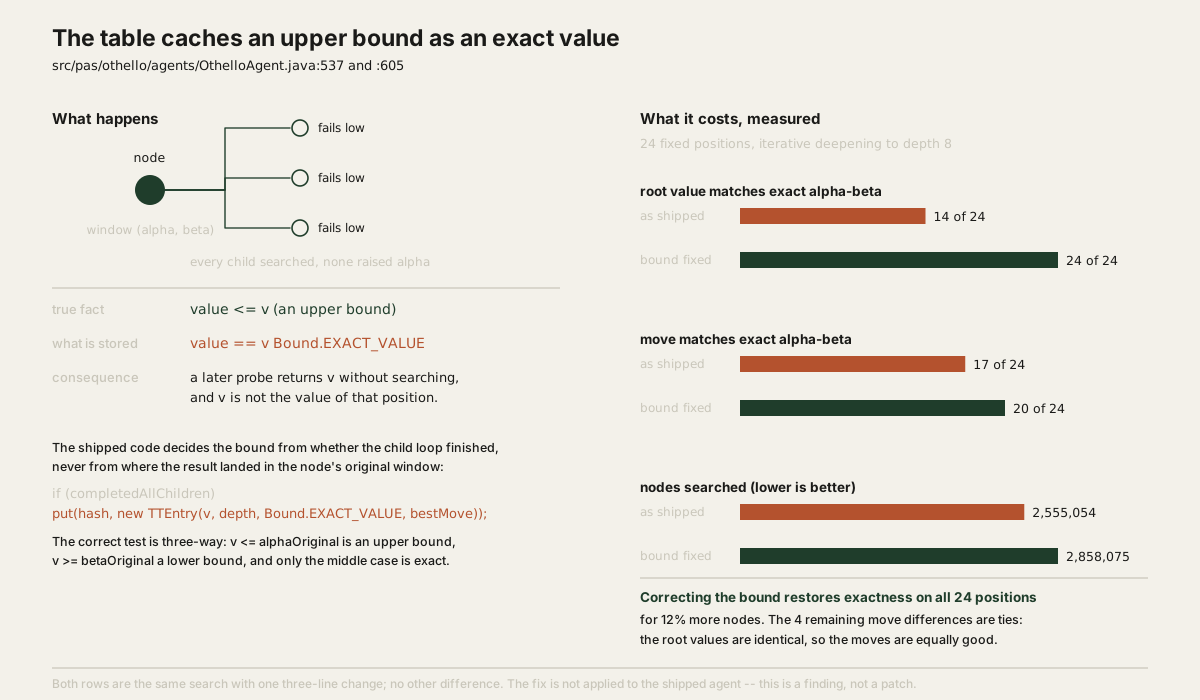
The measurements explain why. A bug in the position memory stored some partial results as final ones, so the search was correct on only 14 of 24 test positions; fixing it restored all 24. Multi-ProbCut's settings were also too aggressive, so it often cut lines that mattered.
What I built
- Built an Othello engine in Java on alpha-beta search with three further shortcuts: principal variation search, a transposition table that remembers positions, and multi-ProbCut.
- Wrote a 20-feature scoring function (corners, mobility, disc stability) with separate weights for the opening, middle and end of the game.
- Measured each shortcut on its own and found a bug in the position memory: the search was correct on 14 of 24 test positions, and on all 24 once fixed.
Results in detail
Does the pruning make it stronger, not just faster?
all-on vs each earlier configuration · 100 ms per move · 60 games each · 6 random opening plies
The all-on search reaches +1.9 more ply per move and still loses ground to PVS, PVS + TT: the depth it buys is not worth what multi-ProbCut gets wrong.
The control points at multi-ProbCut: against PVS + multi-ProbCut, the one opponent that also runs it, the result is level (49%, interval [37, 61]). Every loss is to an opponent that does not run it.
Intervals are 95% Wilson on the score. A bar whose interval crosses "even" is not a result, it is a coin flip with this many games.
Colours alternate so each configuration plays both sides of every opening. Depth reached is the mean completed iterative-deepening depth per move.


Technical details
The full list of measured results behind this project.
Show all 10 measurements
| Measurement | Value |
|---|---|
| nodes per second | 37k nodes/s |
| effective branching factor at depth 5 | 4.45 with everything on, against 11.80 unpruned (median of N(d)^(1/d) over 24 positions) |
| depth reached in 2000 ms | 12 ply median (range 7-16). Nominal: this is the deepest completed iterative-deepening iteration, and multi-ProbCut prunes hard enough that a nominal depth-16 search here is not an exhaustive depth-16 search |
| pruning percentage | 99.40% of the depth-6 tree never visited |
| node reduction, all optimisations vs plain alpha-beta | 15.5x fewer nodes, 13.4x faster |
| evaluation function | coin parity, corner control, corner adjacency (one- and two-square), mobility (own, opponent, normalised difference) and disc stability, 20 features in all, with a separate weight vector per game stage (early / mid / end) tuned offline with Optuna |
| root value matches exact alpha-beta (depth 8, 24 positions) | transposition table as shipped 14/24; with the bound classified correctly 24/24, for 12% more nodes; all optimisations on 4/24 |
| node reduction over the recorded game, at the depth it was played (depth 6) | 6.9x fewer nodes over all 60 searched plies (median 2.7x per move, range 0.93x-25.9x). This is a different measurement from the 15.5x ablation figure, which is depth 8 over a separate 24-position set; the two are not interchangeable. |
| strength at equal time | 42% vs plain alpha-beta (23W 32L 5D); 31% vs PVS (17W 40L 3D); 36% vs PVS + TT (19W 36L 5D); 49% vs PVS + multi-ProbCut (29W 30L 1D) |
| leaf evaluations at the heuristic's clamp | 66.3% of leaf evaluations return the +/-63.99 limit |
Limitations (11)
- The clip's bottom strip reports a depth-6 re-search of the recorded game, where the full configuration visits 6.9x fewer nodes than plain alpha-beta over the game and 7.0x across the moves shown. That is not the 15.5x headline, which comes from the depth-8 ablation over a different 24-position set. Deeper searches and midgame-only positions both favour the pruning more; the endgame plies in this game favour it much less (down to 0.93x, where the optimised search visits slightly more nodes than plain alpha-beta).
- "Depth reached in 2000 ms" is a nominal iterative-deepening depth. With multi-ProbCut on, the search is not even monotone in depth: at depth 9 it visits fewer nodes than at depth 8 on 7 of 24 positions. Read the depth number as "how deep the iteration counter got", not as an exhaustive search.
- The agent's multi-ProbCut parameters are hardcoded to the same values at every height (OthelloAgent.java:206-209: d=2/3, t=2.0/2.2, a=1, b=0, s=1.5) rather than fitted by regression as the technique requires. That gives a cut margin of about 3 evaluation points on a function whose range is +/-64, which is why the speculative cuts fire so often and change the answer so often.
- The shipped transposition table caches upper-bound results as exact values (OthelloAgent.java:537 and :605). Measured effect: the search returns exact alpha-beta's root value on only 14 of 24 positions at depth 8. This is a defect in the code under test, reported here rather than fixed; the project's sources were not edited.
- The ablation runs an instrumented port of the agent's search (portfolio/othello/java), not the shipped OthelloAgent class, because the shipped search is private and time-driven and cannot be run at a fixed depth without editing it. Exactly what was checked: unpruned minimax, alpha-beta, PVS and PVS+TT return identical root values and identical best moves at depth 4 on the first four positions; PVS matches alpha-beta on root value and best move on all 24 positions at depth 8; and PVS+TT with the bound classified correctly matches alpha-beta's root value on all 24. That is what exact search must do, but the port is still a port, not the class that plays.
- The port drops the shipped agent's wall-clock guards (TIME_BUFFER_*), its aspiration windows and its endgame exact-solve branch. Those matter under a real clock and are absent from these numbers.
- 66% of leaf evaluations return the evaluation's +/-63.99 clamp, so at these depths a large share of leaves are indistinguishable to the search. This is a real weakness of the evaluation function, not a measurement artefact.
- Wall-clock figures are a single run on one machine (Apple M4, Zulu JDK 8, single thread) after a JIT warm-up pass. Node counts are exact and deterministic; times are not.
- The recorded game is a mirror match: both sides run the same fully optimised search. It demonstrates the search, it does not measure strength.
- Strength was measured only between these five configurations. The library ships no graded reference opponents (only RandomAgent), so there is no external rating anchor.
- The 24 positions come from random legal play to ply 24, not from human or engine games, so they are representative of arbitrary midgames rather than of strong play.